
Government Portal SEO & Automation Case Study By Shrazen
Building a scalable government jobs publishing platform with custom development, content automation, structured recruitment architecture, and search-led information delivery across India.
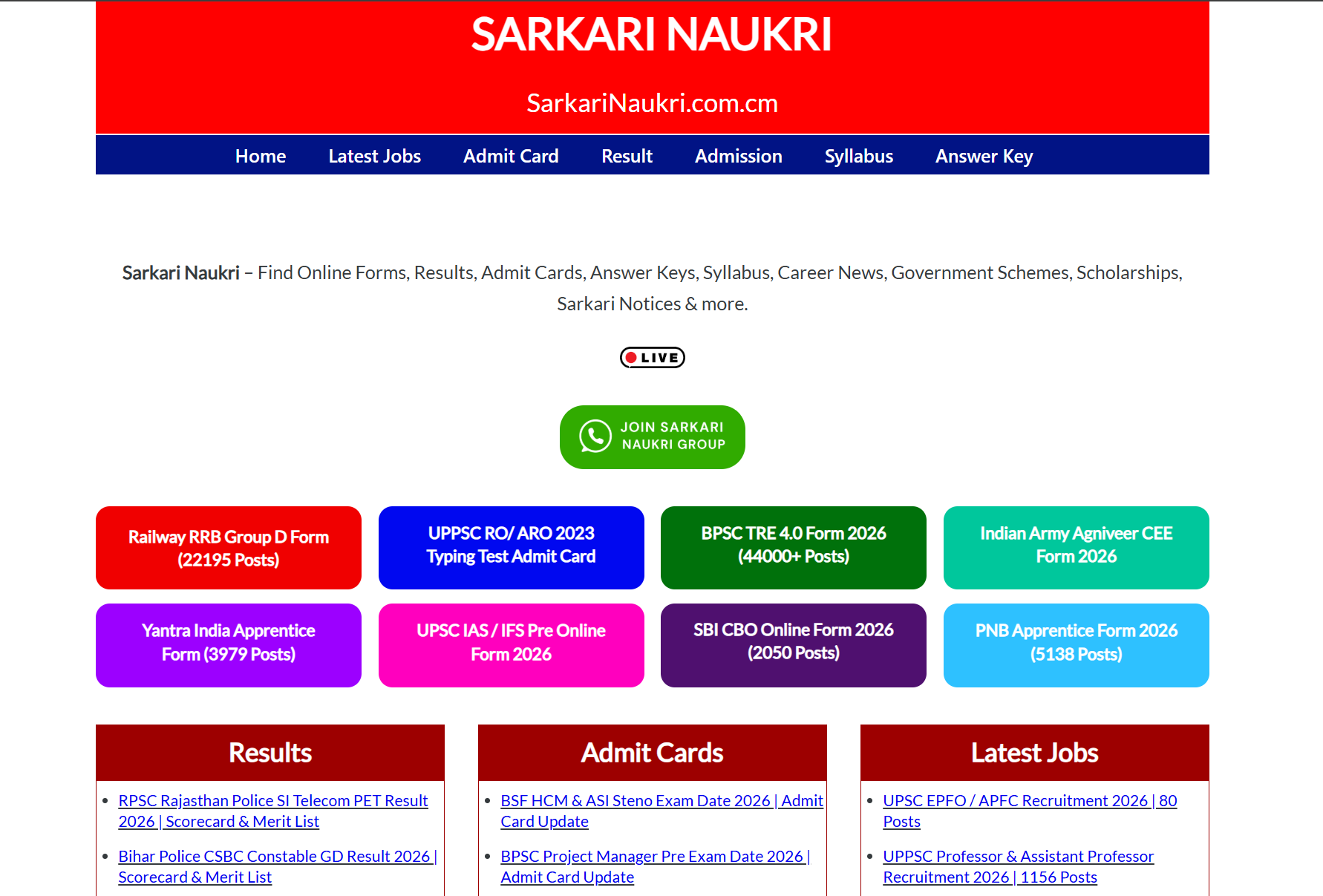

SarkariNaukri.com.cm — Scalable Government Recruitment Portal
India • Government Jobs, Recruitment & Education Information Platform
SarkariNaukri.com.cm is a digital publishing platform designed to organize and distribute government recruitment notifications, exam schedules, admit cards, answer keys, results, syllabi, and admissions updates for millions of job aspirants across India. The portal aggregates active recruitment notices from central and state organizations including UPSC, SSC, Railways, State PSCs, Banking, Police, and Educational Boards.
The Core Engineering & SEO Objectives
Scalable Publishing Platform
Architect a high-capacity website capable of accommodating thousands of recruitment, result, admit-card, and syllabus pages without structural disorganization.
Automated Content Workflows
Develop a structured blog automation pipeline to normalize raw recruitment notices into predictable, SEO-optimized page templates while reducing manual overhead.
Search-Led Intent Architecture
Structure the site taxonomy around search intent and query formulas (Organization + Post + Intent + Year) to capture both broad head terms and long-tail organic queries.
The Challenge: Navigating Fragmented Search Behavior Across Recruitment Lifecycles
Unlike a corporate website that updates pages quarterly, a Sarkari Naukri portal must manage continuous, fast-moving changes across hundreds of active recruitment cycles.
Search behavior in government recruitment is highly fragmented and evolves dramatically across four distinct phases of a single hiring process:
- Before Application: Searches focus on vacancies (e.g., "SSC recruitment 2026", "SBI CBO vacancy", "latest Sarkari Naukri today").
- During Application: Searches focus on actions and constraints (e.g., "SBI CBO apply online", "SSC form last date", "eligibility & age limit").
- Before Examination: Searches target logistics (e.g., "SSC admit card download", "exam date 2026", "exam city & syllabus").
- After Examination: Searches focus on results (e.g., "SSC answer key PDF", "Bihar Police result", "cut-off & merit list").
"The biggest challenge in a government job portal is not publishing one good article. It is publishing and maintaining thousands of highly structured, frequently changing pages without allowing the site to become disorganized."
Targeted Search Intent Vectors
- Head TermsDomain Topical Authority
Broad terms like "Sarkari Naukri", "Sarkari Result", "latest govt jobs".
- Transactional JobsActive Application Intent
"SSC recruitment 2026", "Railway online form", "UPSC notification".
- Result IntentPost-Exam Verification
"Bihar Police result", "SSC merit list", "scorecard download".
- Admit Card & Exam DateTime-Sensitive Logistics
"admit card download link", "exam city status", "hall ticket".
- Answer Key & SyllabusPreparation & Response
"BPSC answer key PDF", "exam pattern", "syllabus download".
Building the Platform Around Search Intent
Traditional blog structures mix unrelated articles into a single reverse-chronological stream. Shrazen engineered a multi-hub architecture connecting specific user intent directly to specialized content categories.
Homepage → Flat Blog Stream → Unrelated Posts
Friction: Weak semantic context for search engines, difficult user navigation, duplicate query cannibalization across recruitment stages.
Homepage → Intent Destinations (Jobs, Results, Admit Cards, Answer Keys, Syllabus, Admissions) → Evolving Post Stages
Clarity: Dedicated URL pathways for each stage of recruitment, structured internal links, and instant answer discovery for visitors.
The Search Query Formula & Keyword Architecture
Mapping government job search demand into structured, scalable keyword formulas: Organization + Post/Exam + Intent + Year.
| Keyword Intent Layer | Target Search Formula & Examples | Site Destination | Strategic Value |
|---|---|---|---|
| Layer 1: Head Terms | Sarkari Naukri, Sarkari Result, government jobs, latest govt vacancy | Homepage & Category Hubs | Topical Relevance |
| Layer 2: Transactional Recruitment | [Org] + [Post] + Recruitment + [Year] (e.g. UPSC EPFO Recruitment 2026) | Latest Jobs Section | Active Applicant Capture |
| Layer 3: Result Intent | [Org] + [Exam] + Result + [Year] (e.g. Bihar Police Constable Result) | Results Hub | Post-Exam Demand |
| Layer 4: Admit Card & Exam Date | [Exam] + Admit Card + Download / [Org] Exam Date | Admit Card Section | Time-Sensitive Traffic |
| Layer 5: Answer Key Intent | [Exam] + Answer Key PDF / Response Sheet / Objection Form | Answer Key Hub | Immediate Post-Exam Search |
| Layer 6: Education & Prep | [Exam] + Syllabus / Exam Pattern / Qualification Eligibility | Syllabus & Admissions | Informational Top-of-Funnel |
Automated Blog Publishing Pipeline
Treating publishing as a system design problem: converting raw notification data into structured, verified, SEO-ready articles automatically.
1. Data Field Extraction & Normalization
Raw recruitment notices are parsed into normalized fields: Organization Name, Post Title, Total Vacancies, Application Start/End Dates, Age Limits, Application Fees, Selection Process, and Official PDF links.
2. Dynamic Content & Title Generation
Standardized title formulas (e.g., "[Org] [Post] Recruitment 2026: Apply Online for [Vacancies] Posts") and structured HTML tables are generated automatically to maintain brand and SEO consistency.
3. Smart Lifecycle Internal Linking
The system connects recruitment pages across their full lifecycle—automatically linking active job posts to future syllabus, admit card, answer key, and result updates as they occur.
4. Editorial Verification & Quality Control
Before publishing, automated checks validate critical dates, fee accuracy, canonical URLs, category mapping, and official source links to prevent hallucinated or duplicate data.
Designing Pages for AI Search & Answer Engines
Modern job aspirants query conversational AI platforms (Google AI Overviews, Perplexity, ChatGPT) with complete intent questions. SarkariNaukri.com.cm pages are structured with extractable data blocks so answer engines can quote facts directly.
Extractable Answer Schemas for AI Agents
Instead of hiding details in lengthy paragraphs, every recruitment post begins with a prominent Fast Facts Summary Table.
Machine crawlers extract normalized data pairs instantly: Organization, Post, Vacancy Count, Application Status, Last Date, Qualification, and Verification Link.
"When an answer engine processes a prompt like 'What government jobs can graduates apply for closing this week?', structured tables allow machine models to cite SarkariNaukri.com.cm as an accurate source."
Targeted Conversational AI Prompts
- Discovery Prompts"Which Sarkari Naukri forms are open right now?"
Surfaced via Latest Jobs category dynamic tables.
- Eligibility Prompts"Which government jobs can I apply for after 12th?"
Extracted from qualification-tagged data fields.
- Deadline Prompts"What is the last date for Railway Group D form?"
Derived directly from normalized date tables.
- Result Prompts"Has the Bihar Police Constable result been released?"
Cited from real-time status badges in the Results section.
Scalability, Freshness & Future SEO Opportunities
Extending the system's reach through entity mapping, freshness management, and programmatic expansion vectors.
Freshness as a Product Feature
- Published vs. Last Updated Dates
Displays clear update stamps (e.g. UPSC CMS page) so candidates and search crawlers recognize fresh revisions instantly.
- Lifecycle Status Tracking
Updates the same core URL when deadlines are extended or corrigendums are published, maintaining established page authority.
- Official Document Hosting
Links directly to hosted recruitment PDFs and official authority sources to build user trust and meet quality standards.
Programmatic SEO Expansion Vectors
- Qualification Hubs
Filter jobs by education (10th Pass, 12th Pass, Graduate, Engineering, ITI) without creating duplicate post bodies.
- State-Level Destinations
Regional hubs for Bihar, Uttar Pradesh, Rajasthan, Delhi, and Madhya Pradesh government jobs.
- Organization Hubs
Centralized pages linking all active notices, admit cards, and results for key bodies like SSC, UPSC, RRB, and SBI.
Structured Publishing
Standardized section schemas (Fast Facts, Dates, Fees, Vacancies, Official Links) across every recruitment page.
Blog Automation Workflow
Automates repetitive formatting and tagging while keeping editorial controls focused on accuracy.
Canonical Intent Ownership
Prevents keyword cannibalization by keeping one authority URL per recruitment stage.
Technical SEO Controls
Maintains crawl efficiency, fast mobile performance, XML sitemap updates, and clean canonical structure.
Need a Scalable Content Website or Automated Publishing System?
Content-heavy portals require more than a basic CMS setup. From custom web engineering and structured content models to blog automation and search architecture, Shrazen builds platforms designed for continuous organic growth.