
How Shrazen Built An Ecommerce Experience For Roopvastra
Fashion E-commerce Website Development Case Study | Saree Website Development, Conversion UX & SEO-Ready Store Architecture
Roopvastra
Indian Ethnic Fashion & Saree E-commerce • Nationwide Delivery
Roopvastra is an Indian fashion e-commerce brand focused primarily on sarees—including Banarasi Sarees, Linen Sarees, Chiffon Sarees, Cotton Sarees, and Rangoli Sarees—alongside lehenga cholis and kurtis. For Shrazen, the objective was to architect a storefront where fashion could be discovered visually, collections browsed intuitively, offers drive urgency, and customers move from inspiration to purchase with zero friction.
The Three Core Strategic Objectives
Category-Led Discovery
Separate saree inventory into distinct fabric hubs (Banarasi, Linen, Chiffon, Cotton, Rangoli) so shoppers find exact fabric preferences instantly.
Frictionless Path-to-Purchase
Surface products directly on the homepage with 1-click "Add to Bag" triggers and clear percentage discount communication (e.g. ₹999 from ₹2,299).
SEO-Ready E-commerce Architecture
Build a scalable URL and category hierarchy that allows individual saree collections to build independent organic search authority over time.
The Challenge: Fashion Customers Shop Differently
An e-commerce website selling fashion cannot behave like a corporate website. Customers don't want to read five paragraphs before seeing products. They want to browse, compare, scroll, open a product, go back, switch categories, look at another colour, check the price, and repeat until something feels right.
That means the interface needs to get out of the customer's way. For Roopvastra, the homepage was structured around fast product and category discovery rather than long-form brand storytelling.
"Instead of asking 'Where should I start?', the website immediately answers 'What kind of saree are you looking for?'—surfacing Banarasi, Linen, Chiffon, Cotton, and Rangoli collections right on the homepage."
Captured Shopping Intent Vectors
- Fabric PreferenceFabric-Led Search
Shoppers specifically seeking Banarasi, Linen, or Chiffon sarees.
- Promotional UrgencyDiscount Sensitivity
Shoppers responding to Minimum 50% Off site-wide savings.
- Popularity ProofBest Selling Collection
Shoppers seeking social proof on what others are buying.
- Visual Discovery"In the Spotlight" Grid
Immediate product visual cards with price & Add-to-Bag triggers.
- Assisted CommerceWhatsApp Support Link
Direct chat route for pre-purchase questions on fabric & delivery.
Designing Around Browsing Behaviour
Instead of hiding product categories inside a complex navigation tree, Roopvastra exposes dedicated discovery paths for each major saree collection directly on the homepage.
Static Uncategorized Catalogue
Friction: Single massive product dump, generic navigation, hidden fabric types, unclear discount value.
Intuitive Discovery & Offer Urgency
Frictionless Shopping: Dedicated fabric hubs (Banarasi, Linen, Chiffon, Cotton, Rangoli), 1-click Add to Bag, transparent strike-through pricing.
E-commerce Merchandising & Feature Architecture
Demonstrating how structured user experience decisions turn window-browsing into completed transactions.
| Storefront Layer / Feature | Implementation Strategy | Customer Shopping Intent | E-commerce Impact |
|---|---|---|---|
| Fabric Category Hubs | Banarasi, Linen, Chiffon, Cotton, Rangoli | Targeted Fabric Browsing | Eliminates category navigation friction & supports SEO |
| "In the Spotlight" Grid | Direct Product Cards | Visual Discovery & Speed | Surfaces featured products directly on homepage |
| Promotional Discount Callouts | Min 50% Off / Strike-through | Price & Offer Urgency | Clear savings calculation (e.g. ₹999 from ₹2,299) |
| Best Selling Destination | Dedicated Collection | Social Proof & Recommendation | Reduces decision fatigue for new shoppers |
| 1-Click "Add to Bag" | In-Card Purchase Action | Immediate Buying Action | Shortens checkout journey by removing extra clicks |
| WhatsApp Commerce Support | Direct Chat Integration | Pre-Purchase Inquiry / Trust | Bridges browsing and buying for hesitant shoppers |
Deep Dive: How Key Victories Were Won
1. Turning Saree Categories Into Shopping Destinations
Roopvastra separates sarees into meaningful fabric hubs—Banarasi, Linen, Chiffon, Cotton, and Rangoli. Someone seeking Linen doesn't want to wade through Banarasi products; dedicated hubs make shopping effortless while establishing strong SEO category relevance.
2. Bringing Products Forward Immediately
Surfacing product cards with names, pricing, discounts, and "Add to Bag" triggers in "In the Spotlight" ensures customers move rapidly from homepage landing to product discovery to cart creation.
3. Pricing & Discount Transparency
Prominently communicating "Minimum 50% Off" alongside strike-through pricing (e.g., ₹999 from ₹2,299) eliminates math for shoppers and reinforces value at first glance.
4. Supporting Purchases With WhatsApp
For Indian e-commerce, WhatsApp provides a vital bridge for questions about fabric, blouse pieces, or delivery times—turning potential cart abandonment into answered inquiries and completed orders.
Storefront UX & Customer Journey Proof
Visual proof demonstrating how Roopvastra’s structured fashion storefront turns casual browsing into completed orders.
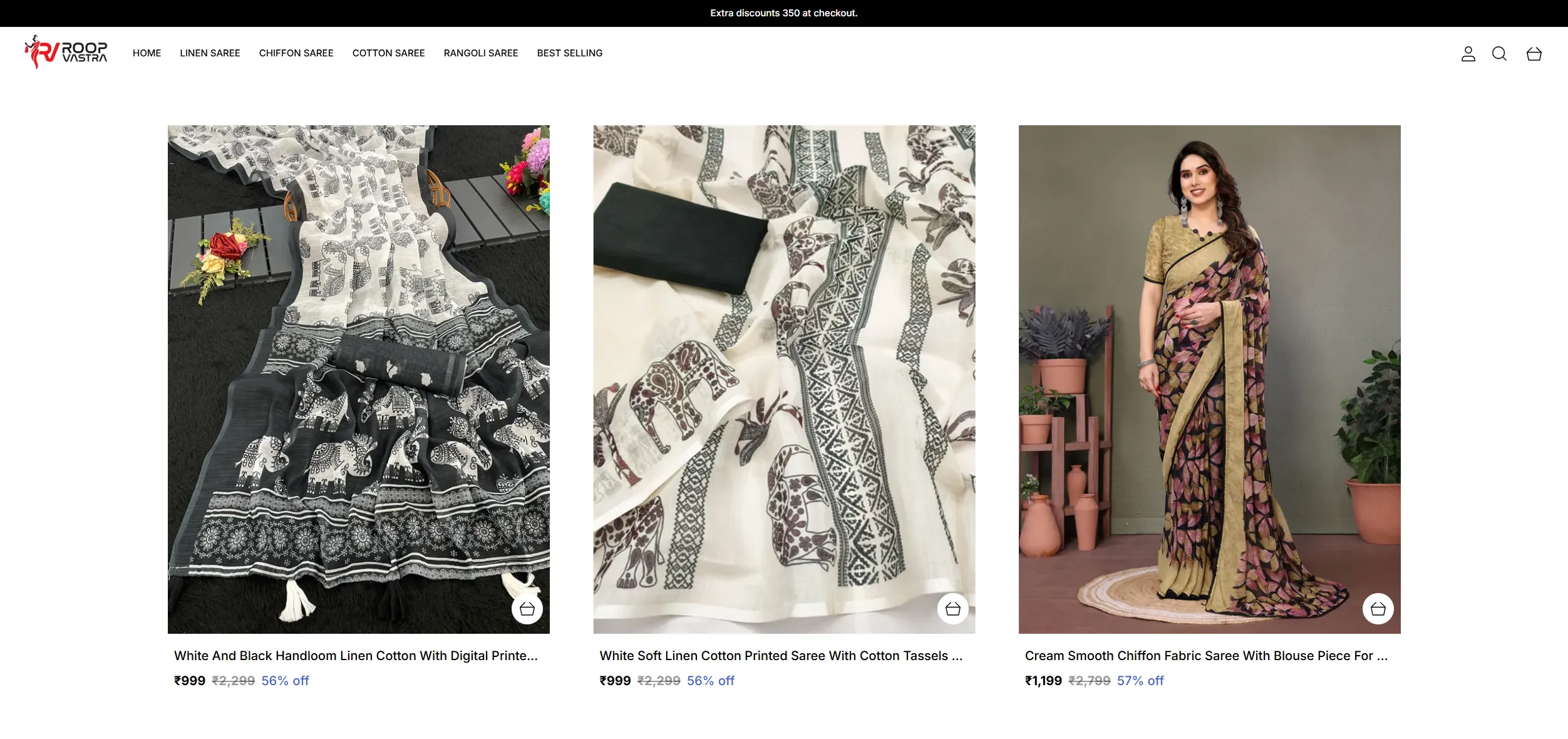
Live Roopvastra header exposing dedicated fabric categories (Linen, Chiffon, Cotton, Rangoli, Best Selling) alongside product cards with 56%–57% discounts and 1-click cart icons.
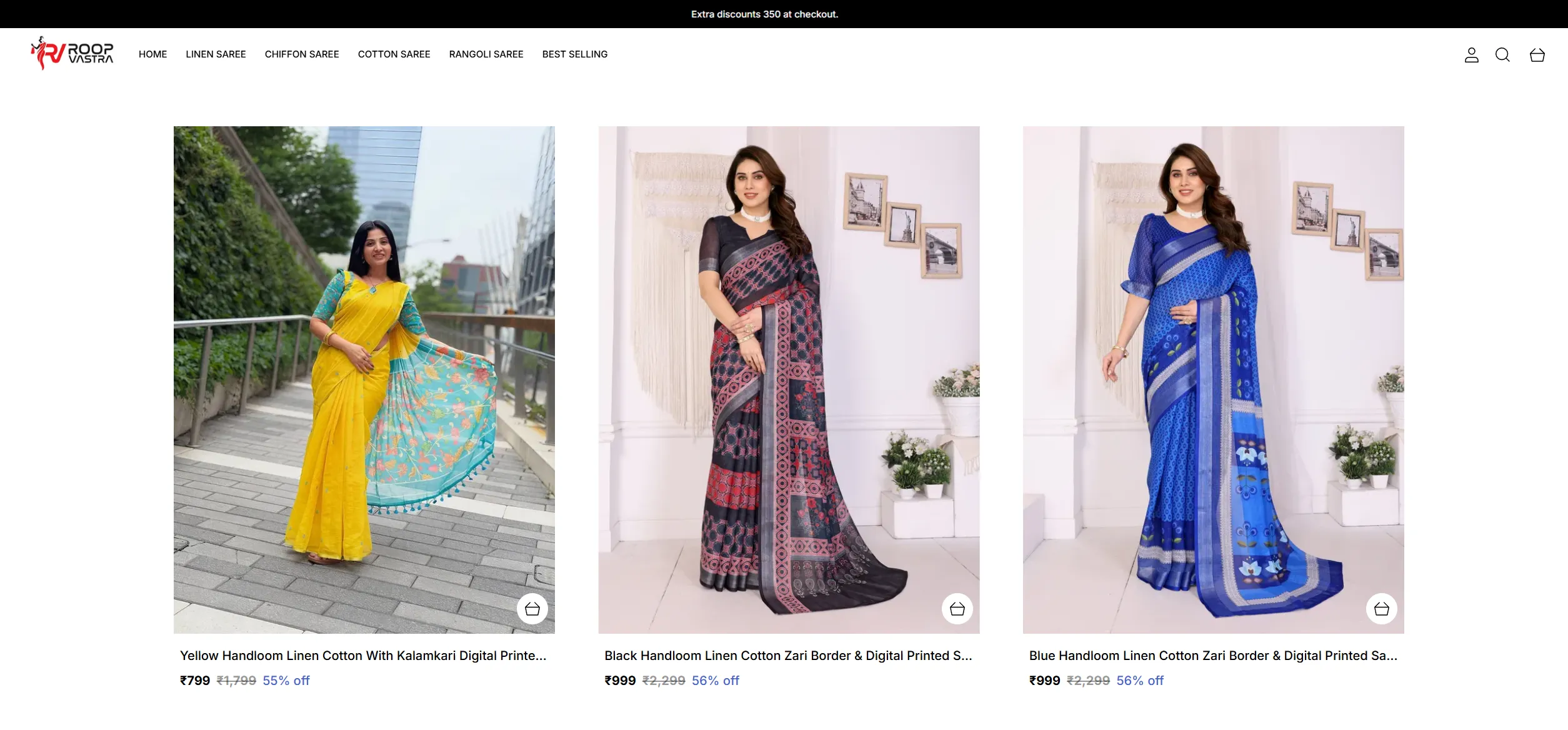
Surfacing high-resolution model photography for Handloom Linen Cotton sarees with explicit pricing (₹799 & ₹999), strike-through savings (55%–56% off), and instant bag action buttons.
What Made the Storefront Work?
1. Category-Based Shopping
Dedicated pathways for major saree styles (Banarasi, Linen, Chiffon, Cotton, Rangoli).
2. Product-Led Homepage
Surfaces purchasable products immediately rather than functioning only as a brand introduction.
3. Strong Promotional Visibility
Site-wide discounts and product-level price reductions are clearly communicated.
4. Direct Add-to-Bag Actions
Product cards shorten the path toward purchase by removing unnecessary intermediate clicks.
5. WhatsApp Support
Customers have a direct support route outside the checkout flow for pre-purchase reassurance.
6. SEO-Ready Structure
Major saree types exist as distinct destinations that can be strengthened independently over time.
Make Them Stop. Make Them Explore. Make It Easy to Buy.
Is your fashion brand still selling through a catalogue instead of a digital experience? Talk to Shrazen about building a high-converting e-commerce website designed around how people actually shop.